
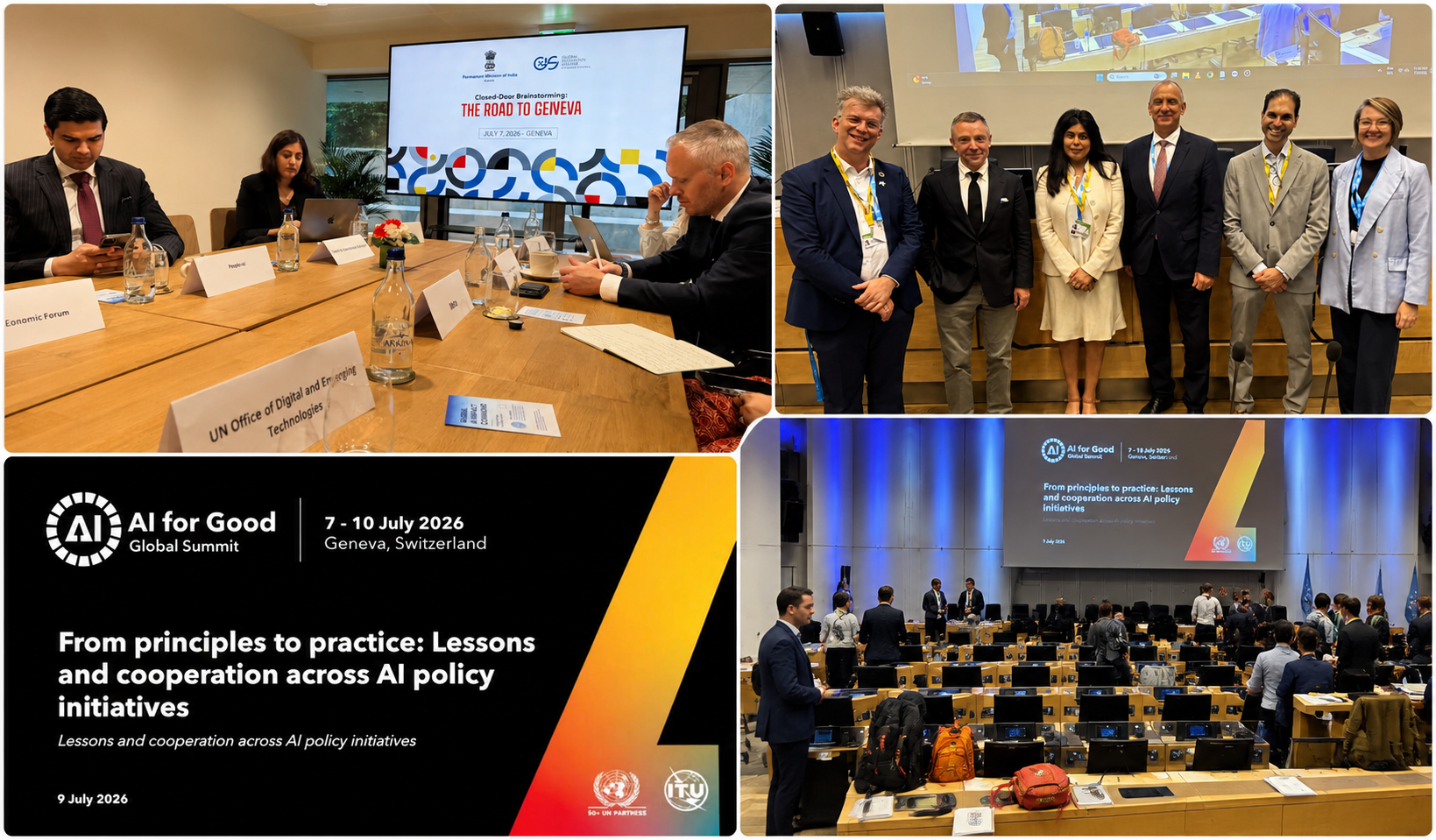
Five days. Three major events. More than 12,000 participants from 177 countries. Geneva's AI for Good and WSIS week once again confirmed the city's standing as the beating heart of global digital cooperation and RegHorizon was in the thick of it.
Ayisha Piotti, Managing Partner of RegHorizon, contributed across the week: speaking at the Permanent Mission of India's closed-door roundtable, "The Road to Geneva," on how the Switzerland-India AI partnership can serve as a model for inclusive, Global South-oriented AI governance; joining the WSIS panel on strengthening resilience in an AI-driven information environment, hosted by the Permanent Mission of Latvia; moderating the International Telecommunication Union's invitation-only leaders' roundtable, "Moving AI Policy From Principles to Practice," alongside Secretary-General Doreen Bogdan-Martin and heads of major AI policy initiatives from over fifty countries; and moderating the Council of Europe CDNET Secretariat session, "Making AI Safe in the Real World."
Across those rooms and the many side meetings between them a consistent picture of global AI governance emerged. Three themes stood out.
The Gap Is No Longer Principles. It Is Implementation.
The world is not short of policy anchors. The Council of Europe's Framework Convention grounds AI in human rights; the UN's Scientific Panel has delivered its report on risks; international standards bodies such as ISO and IEC are making real progress on socio-technical standards. What is missing is implementation support: capacity building for the public sector, development finance for countries adopting these frameworks, and the political will especially at the local level to fund the processes and institutions that turn commitments into practice. AI-literate citizens, empowered to act, are part of that infrastructure too.
Convergence Over Harmonisation
Fully harmonised regulatory frameworks remain distant, and waiting for them would be a mistake. The more pragmatic path is to identify areas of genuine convergence including where common red lines can be drawn and build outward from there. Notably, countries are not waiting: many are experimenting and innovating in the policy space at national level, and a striking number of them are in the Global South.
Momentum Toward 2027
The week also confirmed that the road to the 2027 Global AI Summit in Geneva runs through real, sequenced milestones including the India AI Impact Summit 2026, whose momentum can be carried forward into concrete, value-added solutions. The task is to combine complementary strengths: pragmatic, pro-innovation approaches that drive economic growth and empower communities, while preserving democratic values and human rights.
The future of AI governance is promising, but it will not build itself; every actor has a role to play. Our next milestone is the AI Policy Summit in Zurich on 29 and 30 September, one of many stops, including the AI House in Davos, on the road to Geneva 2027.